
The Institutional Bypass Problem:
Why Mexico’s Security Architecture Forces the CIA to Operate Outside the Law, and What to Do About It

ABSTRACT
The deaths of two CIA officers in Chihuahua in April 2026 are not a diplomatic incident. They are the clearest evidence to date of a structural paradox that has been developing for two decades at the core of U.S.-Mexico security cooperation: Mexico’s federal security chain is sufficiently penetrated by organised crime that even its closest ally has concluded it cannot safely operate through it. This paper argues that the institutional bypass, far from being a reckless infraction, is the predictable result of twenty years of state infiltration. The appropriate policy response is not to condemn the bypass but to build the bilateral framework that makes it unnecessary. Absent that framework, the alternative is not sovereignty. It is the cartel.
I. WHAT HAPPENED IN CHIHUAHUA, AND WHY THE DETAILS MATTER
In the early hours of April 19, 2026, four people died when their vehicle lost control on a mountain road in the Sierra Tarahumara and fell into a ravine. Two were officials of the Chihuahua State Investigation Agency. The other two were American citizens whose identities no government has formally confirmed, though the Washington Post, the New York Times, CNN, and the Associated Press, each citing independent sources, identify them as CIA officers engaged in expanded counternarcotics operations.
The operational context is not incidental. The convoy was returning from an action in the municipality of Morelos that resulted in the seizure of six synthetic drug laboratories, described by Chihuahua authorities as one of the largest such finds in the state’s recent history. According to investigative journalist Luis Chaparro, it was American intelligence that located the laboratory complex in the first place. Mexican state forces had not found it. The CIA officers were not passing through.
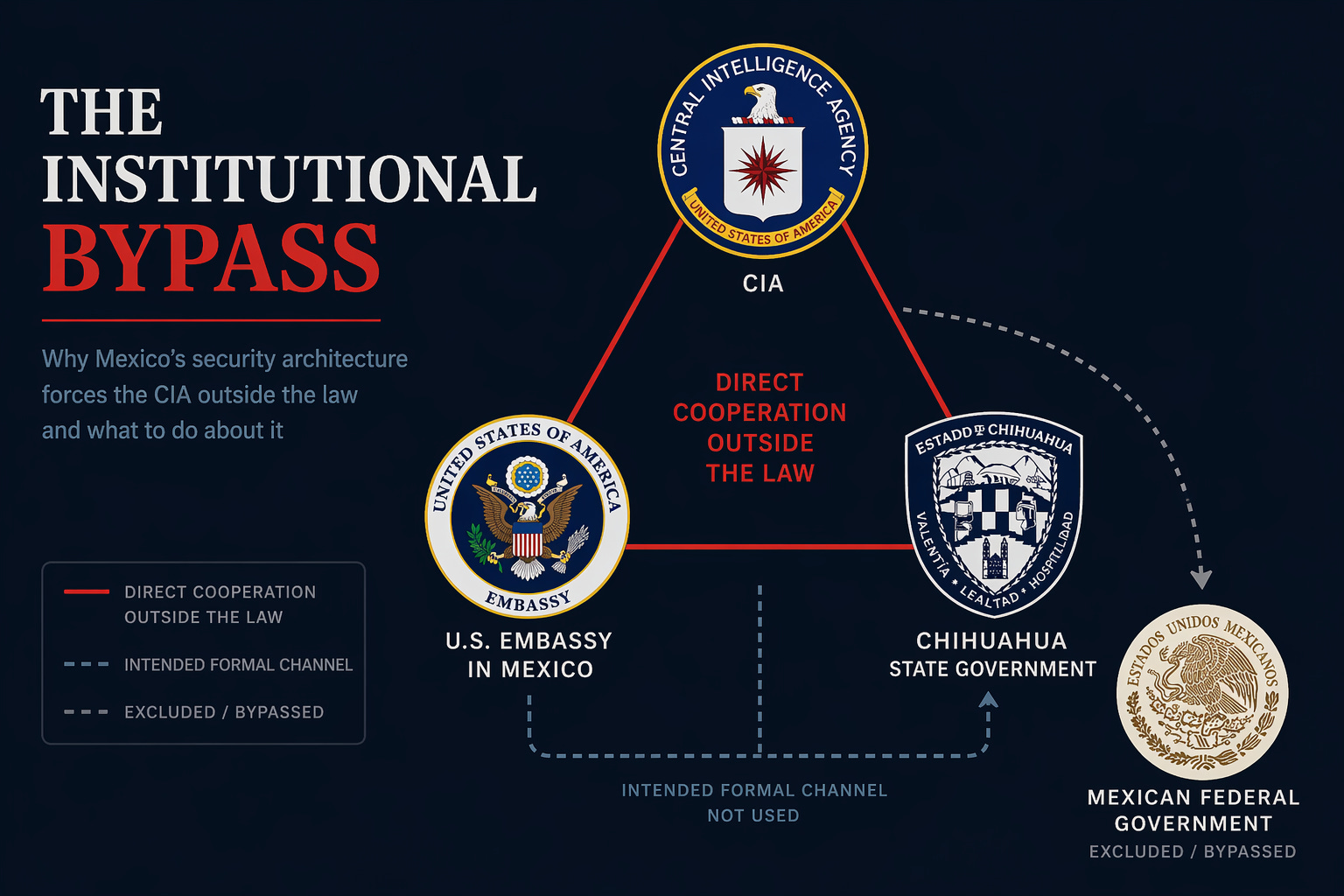
What makes this case worth sustained analysis is not the accident itself. It is the institutional architecture that produced it. The American officers were not coordinating with the Mexican federal government. They were not operating under any established bilateral agreement. They were working directly with the Chihuahua state government, controlled by the opposition PAN party, in an operation three months in the planning that involved forty Mexican security elements and the national Army, and of which Claudia Sheinbaum’s government, by the president’s own public admission, had no prior knowledge.
A three-month operation. Forty Mexican security elements. Army participation. And the president of Mexico learned about it from the American press. That is not a diplomatic incident. It is a diagnostic.
This is the institutional bypass. It deserves analysis that goes beyond the standard diplomatic script.
II. THE LEGAL FRAMEWORK AND THE PARADOX IT CANNOT RESOLVE
The law is unambiguous
Article 73 of Mexico’s National Security Law does not leave much room for interpretation. Any foreign agent operating on Mexican territory must do so under federal government supervision, within the framework of bilateral agreements signed by the Mexican state, and with the knowledge and authorisation of the presidency of the republic. Not a state governor. Not a state attorney general. The federal government. The text is explicit.
The provision was not drafted arbitrarily. It was enacted in December 2020 as a direct response to the Cienfuegos affair: the DEA’s arrest in Los Angeles of General Salvador Cienfuegos Zepeda, a former Secretary of Defense, on charges of providing protection to a cartel. The Lopez Obrador government pressed for his return to Mexico, where he was subsequently exonerated. The legislative reform that followed was meant, in its own terms, to ensure that Mexico would not again learn through the American press what foreign agencies were doing on its soil.
The irony, given what happened in Chihuahua in April 2026, is difficult to overstate.
The paradox no prosecutor can solve
Article 73 is a legitimate law. That is not in dispute. The problem is of a different order: the law assumes the federal security chain is trustworthy, that notifying the federal government is functionally equivalent to guaranteeing an operation will not be compromised. That assumption is reasonable under ordinary conditions. Under Mexico’s current conditions, it is not.
CENTRAL FINDING
If the federal security chain has documented penetrations by organised crime, then complying with Article 73 may mean, in concrete operational terms, notifying the enemy. This does not justify protocol violation. It does identify the structural paradox that makes such violations predictable: a law designed to protect Mexican sovereignty that may, simultaneously, protect those who have infiltrated the institutions that sovereignty is meant to defend.
No prosecutorial investigation resolves that paradox. Only a state that genuinely depurates its own institutions can do that, alongside a bilateral framework sophisticated enough to accommodate that reality in the meantime.
III. THE STRUCTURAL ROOTS OF THE BYPASS: STATE CAPTURE AS BASELINE CONDITION
To understand why the CIA bypassed the Mexican federal government, one needs to understand precisely what it was bypassing. The penetration of organised crime into Mexico’s security institutions is not a marginal phenomenon and not a matter of occasional corruption. The academic security literature, the evidentiary record of U.S. federal courts, and the documented history of the past two decades describe a systemic condition: the infiltration of criminal organisations into police forces, prosecutorial agencies, military commands, and elected governments at every level of the Mexican state.
The Cienfuegos case is the most visible example. It is not the only one. Documented cases include governors, municipal presidents, police commanders, and senior military officers with proven links to criminal organisations. DEA testimony in U.S. federal proceedings has described direct coordination between cartels and high-ranking Mexican federal officials. Academic research published by the Global Initiative Against Transnational Organised Crime documents what analysts call criminal governance arrangements: implicit or explicit agreements between public officials and criminal organisations to coexist, divide territory, and provide mutual protection.
When an intelligence agency assesses with whom it can safely work in Mexico, the infiltration variable is not paranoia. It is risk assessment grounded in decades of documented evidence.
The CIA’s decision to work with the Chihuahua state government rather than the federal chain may have been operationally reasonable for exactly that reason. The State Investigation Agency had been vetted for this specific operation. The federal chain had not been cleared. In intelligence tradecraft, compartmentalisation, that is, limiting an operation’s footprint to those whose reliability has been positively assessed, is standard practice when penetration risk is credible. This does not make the bypass legally acceptable under Mexican law. It makes it institutionally predictable. That distinction is the starting point for any serious policy response.
The DEA vacuum and the CIA expansion
There is a second variable that cannot be ignored. The restrictions on DEA operations in Mexico that followed the Cienfuegos affair, the negotiation of the general’s return and the enactment of Article 73, substantially reduced the operational space available to U.S. drug enforcement agencies within the established bilateral framework. The practical effect was considerable. It was not the intended one.
The vacuum did not stay empty. Under Director John Ratcliffe, and consistent with the Trump administration’s broader reorientation of counterterrorism resources toward counter-cartel operations, the CIA expanded its operational presence in Mexico. By 2025, the agency had begun flying MQ-9 Reaper drones over Mexican territory for cartel infrastructure surveillance, reviewed its authorites regarding the potential use of lethal force against cartel targets, and built working relationships with vetted state-level Mexican law enforcement agencies. Those relationships produced, among other results, the intelligence that led to the killing of CJNG leader Nemesio Oseguera Cervantes in February 2026.
When formal channels close, cooperation does not disappear. It goes informal. And informality produces precisely the opacity that no government, Mexican or American, should find acceptable.
IV. THE POLITICAL DIMENSION: SHEINBAUM, CHIHUAHUA, AND THE FEDERAL-STATE FRACTURE
The bypass has a domestic political dimension that any honest analysis needs to acknowledge, even if doing so is uncomfortable for both sides of the debate. The Chihuahua state government is controlled by the PAN, the centre-right opposition. The federal government is controlled by Morena. The CIA chose to coordinate with the former and not the latter.
This could be read as a purely operational choice: Chihuahua offered a more reliable security apparatus for this particular operation. It could also be read, with some plausibility, as the exploitation of an already-existing political fracture. The federal-state security coordination gap is a structural vulnerability that organised crime has exploited systematically for years, operating in the jurisdictional seams where accountability disperses. A foreign intelligence agency working in that same space, wittingly or not, inserts itself into a domestic conflict it did not create and whose consequences it cannot fully manage.
President Sheinbaum’s statement that she had no prior knowledge of the operation is, on this reading, the most consequential remark of the entire episode. Not because it exonerates her, but because it describes an institutional intelligence failure of the first order. A federal government that failed to detect a three-month joint operation involving forty of its own national security elements and its own army, on its own territory, is either lying or institutionally blind. Both interpretations raise serious questions.
THE CENTRAL DIAGNOSTIC
“I didn’t know” is not a defence. It is an indictment, not of intent but of capacity. A state that cannot track intelligence operations on its own soil does not exercise full sovereignty over that soil, regardless of what Article 73 says.
Some analysts have suggested Sheinbaum may be using the incident as leverage in USMCA negotiations, which face a formal joint review in July 2026. If that reading is correct, the problem compounds itself. Treating the deaths of intelligence officers and an institutional security crisis as a bargaining chip in a trade dispute is a category error. It does not build institutions. It does not produce security. It produces press releases.
V. THE COLOMBIAN PRECEDENT: WHAT GENUINE COOPERATION LOOKS LIKE
The comparison between present-day Mexico and Colombia in the 1990s is academically overworked and analytically indispensable. Colombia at that time faced a condition broadly comparable in scale to what Mexico confronts now: a state substantially captured by narco interests, paramilitary organisations with effective territorial control, roughly 30,000 homicides per year, and security institutions whose reliability was, at best, partial. Plan Colombia, the comprehensive bilateral security cooperation framework negotiated between Bogota and Washington, was politically costly, academically contested, and largely effective.
The Cali cartel was dismantled. So was the Medellin cartel. The Colombian state recovered control over territories it had ceded, in fact, to armed actors. Homicide rates declined in a sustained way. Colombia remains Colombia. Its sovereignty survived the cooperation. What did not survive was Escobar.
The Colombian case is not an argument for unilateral American intervention in Mexico. It needs to be stated plainly, because the comparison is often misused in that direction. It is an argument for building a serious bilateral framework, one with genuine federal oversight, reciprocal supervision, clear operational protocols, and accountability mechanisms for when things go wrong. What happened in Chihuahua was real cooperation producing real results. Six laboratories destroyed. Supply disrupted. What was missing was the architecture that would have made that cooperation legal, visible, and durable.
The problem in Chihuahua was not that there was cooperation. It was the absence of a framework that made cooperation legal, transparent, and accountable to both governments. Building that framework is the task. Not relitigating whether cooperation should exist.
VI. POLICY IMPLICATIONS: FOUR RECOMMENDATIONS
The events of April 2026 clarify at least four policy imperatives. None of them are comfortable. All are necessary.
1. Build the bilateral framework that does not yet exist. Mexico and the United States need a formal, legally grounded, federally supervised cooperation architecture for joint counternarcotics intelligence operations. That framework must include mandatory federal notification, bilateral oversight mechanisms, clear operational protocols for field presence, and accountability procedures when operations go wrong. The extradition regime offers a useful model: it is legally robust, procedurally established, and produces results without triggering sovereignty crises. Joint intelligence operations can have the same architecture. What has been consistently missing, across administrations of different political orientations on both sides, is the political will to build it.
2. Acknowledge that Article 73 requires complementary institutional reform. The law is necessary and insufficient. As long as the federal security chain contains documented penetrations by organised crime, Article 73 will reproduce the Chihuahua paradox: a sovereignty protection mechanism that functions simultaneously as an operational security risk. Mexico must invest, credibly and sustainably, in the depuration of its federal security institutions. Not as a condition imposed by Washington, but as a prerequisite for the kind of bilateral cooperation that serves Mexican interests. That process requires independent vetting mechanisms, transparent procedures, and a political commitment that has been absent across every recent administration, without exception.
3. Stop treating the federal-state security coordination gap as a domestic political problem. The fracture between federal and state security competencies is a structural vulnerability that organised crime has exploited systematically for years, and in which foreign intelligence agencies now also operate. Mexico needs a security coordination architecture that functions regardless of partisan alignment between levels of government. The fact that the CIA found it operationally safer to work with a PAN-governed state than with the Morena-governed federal chain is not a commentary on either party. It is a commentary on the absence of a depurated, trustworthy coordination channel. That absence is the problem.
4. Reframe the policy debate from sovereignty to institutional capacity. Mexico’s political discourse treats the bypass primarily as a sovereignty violation. The framing is legally accurate and politically understandable. It is also analyticaly incomplete. A state that cannot detect joint intelligence operations on its own territory, that has documented cartel penetration at multiple institutional levels, and that has produced five consecutive administrations of failed security strategies, cannot invoke sovereignty as a substitute for institutional capacity. The relevant question is not how to keep foreign agencies out. It is how to build Mexican institutions strong enough that foreign agencies can operate with them rather than around them.
VII. CONCLUSION: THE ALTERNATIVE IS NOT SOVEREIGNTY
The institutional bypass documented in Chihuahua in April 2026 is a symptom. The underlying condition is the structural compromise of Mexico’s federal security chain by organised crime: a problem two decades in the making, documented across multiple administrations, and resistant to every surface-level policy response attempted so far.
The CIA did not bypass the Mexican federal government because it disrespects Mexican sovereignty. It did so because its operational risk assessment, grounded in decades of documented evidence of institutional infiltration, concluded that the federal chain could not safely hold the operation. That assessment may have been wrong in this specific case. But it was not unreasonable given the baseline conditions. The appropriate response to that assessment is not diplomatic protest. It is institutional reform.
Mexico has a choice. It can continue invoking Article 73 as a shield against acknowledging its own institutional crisis, producing a sequence of incidents structurally identical to Chihuahua, with different names and different mountain ranges. Or it can treat the bypass as the diagnostic it actually is: evidence that the federal security architecture needs rebuilding from within, and that the bilateral framework which is supposed to sustain it needs constructing from scratch.
The communities of the Sierra Tarahumara cannot wait for that political decision. They live today under the de facto governance of criminal organisations that control their roads, recruit their children, and install laboratories in their mountains, while the Mexican state debates protocols and the American state operates around them. For those communities, sovereignty is not a legal concept. It is the concrete possibility of living without fear in their own land. That sovereignty has been violated, consistently and at scale, without a single prosecutor opening an investigation.
The alternative to bilateral cooperation is not full sovereignty. It is the cartel. Mexico has been making that choice for twenty years without saying so out loud. The deaths in Chihuahua make the cost of that choice visible. The question is whether that visibility produces action.
Two CIA officers died in those mountains. Two Mexican security officials died alongside them. They died doing work that the bilateral framework should have structured, legalised, and made accountable, and that it did none of those things. That is the institutional failure demanding a policy response. Not the bypass. The conditions that made the bypass necessary.
ABOUT THE AUTHOR
The author is a Mexican academic specialising in security studies, organised crime, and U.S.-Latin America relations. The views expressed are the author’s own and do not represent any institutional affiliation.
NOTE ON SOURCES
Factual claims in this paper draw on reporting by the Washington Post, New York Times, CNN, Associated Press, NPR, Infobae, El Universal, El Diario de Chihuahua, and Semanario ZETA; investigative reporting by Luis Chaparro and Azucena Uresti; public statements by President Claudia Sheinbaum and Chihuahua Attorney General Cesar Jauregui at press conferences between April 19 and 22, 2026; academic research by Romain Le-Cour Grandmaison and Pablo Frissard Martinez published by the Global Initiative Against Transnational Organised Crime; and prior analysis by the author on the structural conditions of organised crime infiltration in Mexican security institutions. Where information derives from single-source journalism without official confirmation, it is presented as such.