
The First to Talk Always Gets the Best Deal
The Mérida Surrender and What Comes Next

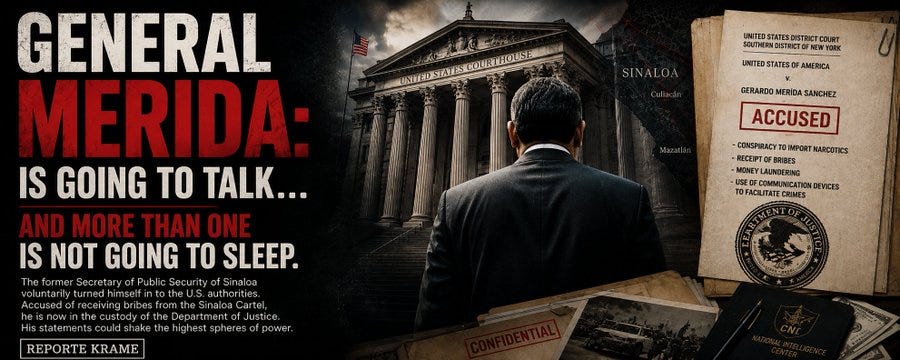
He did not surrender out of fear. He surrendered because he had already negotiated.
On May 11, General Gerardo Mérida Sánchez crossed the border voluntarily and presented himself before U.S. federal authorities. He waived his identity hearing. He accepted transfer to New York. That sequence of decisions is not the behavior of someone in flight. It is the behavior of someone who already knows what is coming, who has already consulted with counsel, calculated his options, and reached a conclusion. In the U.S. federal system, voluntary surrender of this nature almost always precedes a plea agreement. And plea agreements have a currency the Department of Justice knows well: information.
This matters enormously, and here is why.
For decades, one of the most durable unwritten rules of the Mexican military institution has been silence. The armed forces guard their secrets, their loyalties, and their internal hierarchies with a discipline few other state structures can match. When a general voluntarily crosses an international border, appears before a federal court, and is placed in the same detention facility as Rafael Caro Quintero and Joaquín “El Chapo” Guzmán, something shifts. Not only in the case file. In the broader institutional landscape.
Mérida Sánchez had obtained a legal injunction in Mexico just days before his surrender, precisely to shield himself from detention or extradition. He crossed anyway. That detail is not incidental. It is the clearest possible signal that a prior arrangement was already in place.
What a Cooperative Insider Is Actually Worth
Mérida Sánchez was a Division General and former Secretary of Public Security of Sinaloa. According to the indictment filed by the Southern District of New York, he received more than $100,000 per month in cash from Los Chapitos in exchange for non-interference in their operations and advance warning on at least ten raids targeting drug laboratories. He was not a peripheral actor. He was positioned at the precise intersection of military authority, state security apparatus, and one of the most strategically significant territories in North America.
There is a distinction that often gets lost in public commentary on cases like this. Capturing someone is an operational victory. It demonstrates the state can reach those it pursues. Securing voluntary cooperation is something categorically different. It is access to the living memory of a system.
Wiretaps have limits. Criminal informants arrive in court with their credibility under permanent challenge. Financial intelligence can map flows but rarely establishes intent. A state actor who lived inside the apparatus can do something none of those tools can accomplish independently. He can explain the reasoning. Who was notified before a decision was made. How sensitive information moved through the chain of command. What was done with it, and equally important, what was deliberately left undone.
The DOJ absorbed that lesson definitively through the García Luna prosecution. The most consequential cases are not about individual traffickers. They are about structures.
Washington Is No Longer Pursuing Narcos. It Is Pursuing Architecture.
The pattern of DOJ investigations of this scale is well established and consistent. Cases are built in layers. Prosecutors first secure those who can provide information, then use that information to move upward. The trajectory is never downward. It is always up.
Rubén Rocha Moya, Sinaloa’s governor on leave, has already been named in the same federal indictment, alongside nine current and former officials. That threshold has been crossed. Once a cooperating witness of Mérida’s institutional standing sits across from Southern District prosecutors and begins to speak, the evidentiary foundation of the investigation shifts. It moves away from dependence on intercepts and financial records and toward something considerably more difficult to challenge in court: the firsthand testimony of someone who was inside the room.
For Rocha Moya, and for others who appear on the indictment or who have reason to believe they should be concerned, the signal embedded in Mérida’s voluntary surrender is both precise and uncomfortable. The first to negotiate secures the best terms. Those who wait, wait for someone else to have already spoken about them. At that point, their available options contract considerably.
Rocha Moya faces an active extradition request. The legal protections available to him in Mexico today are structurally identical to those Mérida held two weeks ago. The record now shows how durable those protections prove to be once someone on the other side of the file decides to cooperate.
The Question That Cannot Be Avoided
It is at this point that the name of General Audomaro Martínez Zapata enters every serious institutional analysis, and the reasoning deserves careful framing.
There is no formal indictment against him. There is no charge, no public accusation from any court. What exists is a structural question that no honest analyst can responsibly set aside. Audomaro directed the Centro Nacional de Inteligencia (CNI), Mexico’s national intelligence center, for a significant portion of the López Obrador administration. Mérida operated in Sinaloa during that same period. If a cooperative witness of Mérida’s profile begins to speak about chains of command, warning protocols, the handling of sensitive intelligence, and decisions made at the federal level about what to act on and what to ignore, one question becomes unavoidable.
What did federal intelligence know? When did it know it? And what did it decide to do with that knowledge?
Those are not accusations. They are precisely the questions that any rigorous investigation into criminal penetration of state structures eventually reaches. Audomaro’s name appears in this analysis not because evidence links him directly to wrongdoing, but because the position he occupied places him at the center of an institutional logic that the investigation’s own trajectory is already approaching. In intelligence policy terms, that proximity is as uncomfortable as it is structurally real.
The Institutional Trauma García Luna Left in Washington
The García Luna prosecution was a turning point, not only for Mexico, which had to absorb the image of its former Secretary of Public Security convicted in a Manhattan courtroom, but for the conceptual framework through which Washington now approaches its security relationship with the Mexican state.
Before that case, DOJ doctrine focused primarily on criminal figures: cartel leadership, financial operators, high profile traffickers. After García Luna, the model changed in ways that have become institutionally durable.
What is now being pursued are hybrid structures. The spaces where public authority and organized crime share institutional architecture. Where protection is not a favor but a systematized service. Where state intelligence does not combat crime but, in certain operational moments, manages it. That framework is what gives the Mérida case a dimension that extends well beyond Culiacán or even Sinaloa.
The Focus Is Shifting
What was concentrated at the state level is beginning to move. Still cautiously, still within the domain of institutional risk projection rather than established fact. But it is moving. Toward federal networks. Toward those who administered the country’s intelligence apparatus between 2018 and 2024. Toward Mexico City and the decisions that were made, or were deliberately not made, from the upper floors of the national security structure.
The Rocha Moya case carries the potential to evolve from a criminal file into a strategically significant political one. Not because anyone designed it that way from the outset, but because DOJ investigations of this architecture have their own gravitational logic. They move upward. They always move upward. And when the trajectory begins in Sinaloa, the institutional ceiling is considerably higher than many would prefer to acknowledge.
Mexico has spent two decades learning that these cases are always larger than they initially appear. What begins as the story of one individual consistently becomes the story of a system. Whether the Mérida case reaches that scale remains to be seen. But when a general decides to cross the border and sit down with Manhattan prosecutors, the relevant question is no longer whether there will be further consequences. The question is who will be next to receive the call they do not want to receive.
Editorial note: This analysis draws on publicly available information current to the date of publication and on institutional risk projection based on documented precedent. No formal charges exist against officials mentioned beyond those already in the public record. The purpose of this analysis is to anticipate possible institutional dynamics, not to establish criminal responsibility.